|
|
Gerry
Anderson Productions - 1966 to 1977

|
 |
Thunderbirds
is a trademark of  Carlton International Media Limited Carlton International Media Limited
|
|
| |
|
1966 / 1967 Original Novels
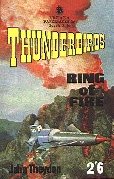  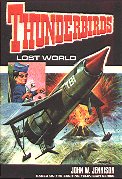
8
original novels authorised
4 by Armada in paperback and 4 by World Distributors
in hardback
Paperback - all by John Theydon
'Thunderbirds'
'Calling Thunderbirds'
'Thunderbirds: Ring of Fire'
'Lady Penelope: The Albanian Affair'
Hardback -
Two Authors
'Thunderbirds: Operation Asteroids' by John W.Jennison
'Thunderbirds: Lost World' by John W.Jennison
'Lady Penelope: Cool For Danger' by Kevin McGarry
'Lady Penelope: A Gallery Of Thieves' by Kevin McGarry

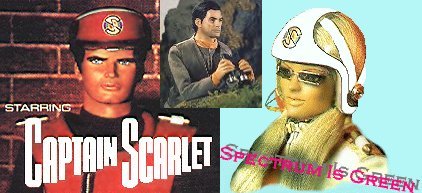
1967 - Captain Scarlet and the Mysterons
A Gerry
Anderson Production
| |
32
episodes made in two blocks - 12 in 1967 and
20 in 1968
First
transmitted: 1st October 1967
Format
by Gerry and Sylvia Anderson
Executive Producer: Gerry Anderson
Produced
by Reg Hill
The
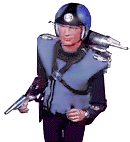
Mars landing by Spectrum, Earth's security
organisation, in 2068, ended in the destruction
of the Mysteron city. Mistakenly believing
themselves to be the victims of an unprovoked
attack, the Mysterons swore revenge and
during their retaliation attacks, two Spectrum
agents, Captains Scarlet and Black, are
killed and duplicated with the power to
recreate themselves even after death. Captain
Black becomes an agent for the Mysterons,
while Captain Scarlet remains loyal to Spectrum
and leads the fight to protect Earth and
Skybase from the revenge of the Mysterons
and their strange reconstructive powers.
Despite
the lyrics of the 'Spectrum' song, it was
never the Mysterons' intention to conquer
the Earth.
|
|
First
use of properly proportioned puppets and the first
series to use the Century 21 dart before the main
title sequences. Notable for the eerie opening scenes,
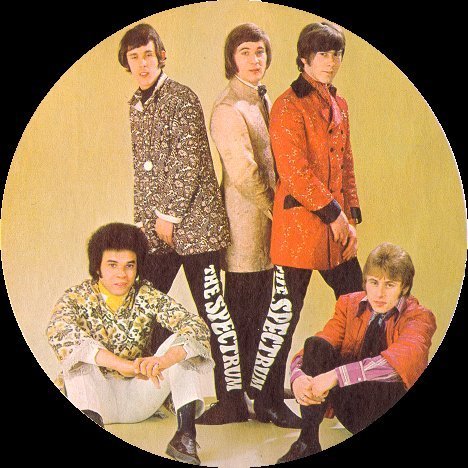
the main theme tune played by The
Spectrum ( who never appeared as a group although
they released a single entitled 'Samantha is mine'
) and the 7 note segue used during the 'strobe-shot'
scene changes.
Each episode had a two week shooting schedule but,
for the first 12 episodes, pairs of episodes were
shot simultaneously over a period of 12 weeks. The
remaining 20 episodes were shot back-to-back with
the film 'Thunderbird 6' over a five month period.
1967
- 1969 Candy and Andy
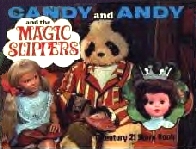  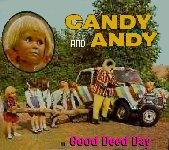 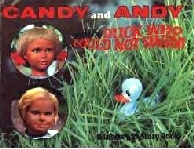
A series
of photo stories about two children that live with
Mr and Mrs Bearanda who are Pandas.
The storyline was intended as a TV series but did
not make the screen.
The characters were first seen in a magazine called
'Candy' published by City Magazines Ltd in co-operation
with Century 21 publishing and edited by Alan Fennel.
Issue 1 appeared on 21st January 1967 and ran to issue
154 on 27th Dec 1969.
Annuals were produced from 1967 to 1969. Story titles
included: Good Deed Day, Rufus To The Rescue, The
Magic Slippers, Penny For The Guy and The Duck Who
Could Not Swim.
1967 - Thunderbird
6
Century 21 Cinema / United
Artists
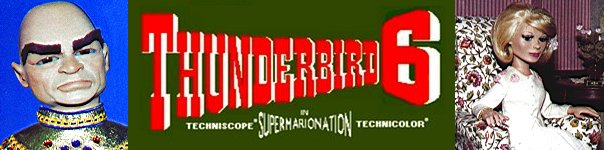
Film -
90 mins Premiere: 29th July 1968
at the Odeon Cinema, London
Executive
Producer: Gerry Anderson
Associate
Producer: John Read Producer: Sylvia
Anderson

A
second crack at the big screen for International Rescue.
This time, featuring Lady Penelope aboard the maiden
voyage of Brains' new airship - 'Skyship One'. It
doesn't take long for Lady P to discover that the
crew are imposters, involved in a plot to bring about
the downfall of International Rescue.
Thunderbird
'6' is, in fact, the biplane in the film. The real
life pilot had to appear in court on charges of dangerous
flying after filming the sequence of flying under
a motorway bridge on the then new, unopened, M40 motorway
at Lane End near High Wycombe.
The charges were dropped!
1968 - Doppelganger (Journey To The Far Side of
the Sun)
Century
21 Cinema / Universal
Film -
101 minutes Premiere:October 8th
1969 at the Odeon Cinema, London
(June 1969 - U.S.A.)
Produced
by Gerry and Sylvia Anderson Associate
Producer: Ernest Holding
Following
the discovery of a new planet on the opposite side
of the sun, EUROSEC, the European Space Exploration
Centre, send a 2-man probe to investigate. The probe
crashes, but it takes the crew a while to realise
that it has crashed on a mirror-image duplicate of
Earth.
Doppelganger
was retitled 'Journey To The Far Side Of The Sun' for
American and Australian audiences. British and European
releases retained the Doppelganger title, which is the
name under which the film is catalogued by the BFI and
the BBFC. It won the 1969 Hollywood Blue Ribbon Award
for best screenplay and was nominated for an academy
award for best special effects. Strangely, only the
American version has been seen on British TV. John Read
left the company during production.
1968 - Joe 90
A Gerry
Anderson Production
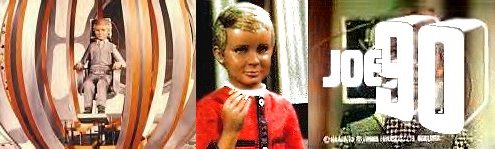
30 episodes First
transmitted: 5th October 1968
Format
by Gerry and Sylvia Anderson
Executive Producer: Reg Hill Producer:
David Lane
Directed
by: Peter Anderson : Leo Eaton : Alan Perry : Ken
Turner : Desmond Saunders
Nine
year old Joe McClaine can acquire the brain patterns
and, therefore, the abilities of anyone, using B.I.G.R.A.T.
( Brain Impulse Galvanoscope Record And Transfer ),
an invention of his adopted father. The ability is
activated whenever he dons his special electronic
glassesand is put to good and frequent use by W.I.N.
- the World Intelligence Network.
Politics
were important at the height of the 'Cold War' - even
in children's series - so, despite the plot of Joe
90's first episode featuring British agent Joe stealing
a Russian fighter plane to restore the balance of
power,there is an explanation at the end of the episode
that there is no conflict between Soviet Russia and
the West. This
was the first time a woman wasn't used to do the voice
of a boy. A real kid - Len Jones - was used, making
the character sound much more realistic.
Production
started at MGM studios, Borehamwood but halted during
the 17th episode when the studio closed due to a switch
to shows containing more live action.. Shooting restarted
six months later at Pinewood. While the puppet stages
closed down and the puppetry staff were made redundant
in January 1969, the Century 21 Studios at Stirling
Road continued to operate until late in 1970, as all
the stages were given over to the filming of special
effects for UFO. Merchandising companies set up around
the puppet series were wound up as was the Century
21 record company. The last issue of TV21 under Century
21 ownership came out on 6th Sept 1969.
1969 - Secret Service
A Gerry
Anderson Production
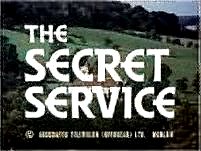
13
episodes First transmitted: 21st
September 1969
Format
by Gerry and Sylvia Anderson Executive
Producer: Reg Hill
Set
in the present day, Father Stanley Unwin and his gardener
Matthew Harding are secret agents for B.I.S.H.O.P.,
a department of British intelligence. They use a device
called a minimiser which can reduce any object in
size - even people.
The
Secret Service was not the first of Gerry Anderson's
series to be set in the present day. Supercar was
also set in the present day. The first season episode
'A Little Art' indicates that the date is around 1960
while the second season episode 'The Day That Time
Stood Still' is specifically set in 1962. This was
the first
series to use puppetry mixed with live action sequences.
1970 - U.F.O.
A Gerry
Anderson production with ATV for ITC worldwide distribution
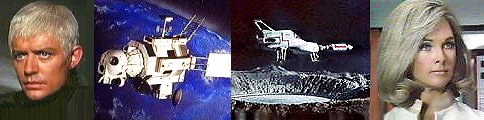
26 episodes First transmitted: 18th September 1970 First transmitted: 18th September 1970
Producer:
Reg HillExecutive Producer: Gerry Anderson
Set
in the, then, near future in 1980, S.H.A.D.O., Supreme
Headquarters Alien Defence Organisation, was set up
to protect Earth from attack by aliens trying to obtain
human organs for transplant. Conveniently based underneath
the Harlington-Straker film studio, both run by Ed
Straker, S.H.A.D.O. also operated a moonbase and the
mobile underwater vehicle Skydiver.
This
series was mostly live action with models used for
the futuristic vehicles, except for the road cars,
which were actual vehicles. UFO starred twelve actors
from the film Doppelganger, seven making regular appearances,
plus the dancer Peter Gordeno and Gabrielle Drake
as Lt. Gay Ellis. When syndicated in America it topped
the New York and L.A. ratings for 17 consecutive weeks.
This was the last production for Century 21, Gerry
Anderson setting up the Group Three company after
this as the contract with Lord Lew Grade had expired.
1972 - The Protectors
A Gerry
Anderson / Group Three production in association with
ATV for ITC worldwide distribution

52 episodes
x 25 mins First transmitted: 29th
September 1972
Created
by Lord Lew Grade
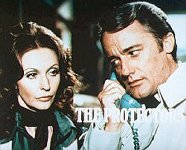
Harry
Rule (Robert Vaughn), Paul Buchet (Tony Anholt) and
the Contessa Caroline Ogilvie Di Contini
(played by the late, wonderful actress Nyree Dawn Porter)
are one team in the Protector organisation that acts
outside the law to bring criminals to justice.
This
was the first Group Three production.
The
powerful theme song, 'Avenues and Alleyways' by Mitch
Murray and Peter Callender was a chart success for Tony
Christie. The memorable five note segue by Mitch Murray
in the song was also used consistently throughout the
incidental music which was composed by John Cameron.
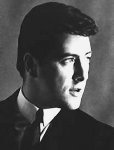
Mitch
Murray
Songwriter who wrote and co-wrote many hits and Number
Ones in the 60s and Seventies
1972 - The Investigator
Starkits
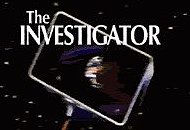
1 pilot
episode x 25 mins Produced
by Gerry Anderson
A
heard, but unseen being from another galaxy enlists
the help of two children, John and Julie, to help
him in his crusade against crime and injustice on
Earth. In this case, to prevent the theft of a relic
from a Maltese church.
Not
transmitted. As in Secret Service, the miniaturisation
of people once again plays a major part in the special
effects and storyline.
1975 - Space 1999
A Gerry
Anderson / Group Three production for ITC worldwide
distribution
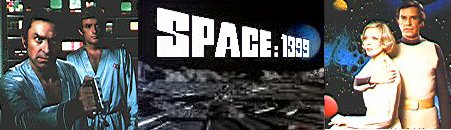
48 x 50
min episodes in two seasons of 24 First
transmitted: Thursday 4th September 1975
Created
by Gerry and Sylvia Anderson Executive
Producer: Gerry Anderson
Producer:
season 1: Sylvia Anderson Producer:
season 2: Fred Freiberger
Set
in the 1990's and the moon has been blasted out of
orbit by the accidental explosion of a radioactive
waste dump, along with moonbase Alpha and its 300
inhabitants commanded by John Koenig. This is the
story of its travels and the Alphans' search for a
new home.
Martin
Landau and Barbara Bain star in this tale of human
survival. Barry Morse left after the first season
and was replaced by a second female lead - Maya, a
metamorph from the planet Psychon - played by Catherine
Schell. Work had already started on a second series
of U.F.O. but as it was not taken up by America, production
quickly changed to Space 1999. The company moved to
the old Hammer site at Bray studios for the special
effects work. To make the space vehicles fly more
smoothly a technique was evolved where the cameras
were moved instead of the model, the background being
superimposed afterwards.

See
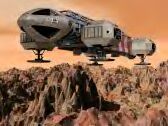
the superb quality EAGLE II pictures at space1999eagle.com
1975 - The Day After Tomorrow - Into Infinity
A Gerry
Anderson / Group Three production for the NBC network

1 episode
x 52 mins
First transmission U.S.A. 9th December 1975 / U.K.
11th December 1976
Produced
by Gerry Anderson Prodn. Supervisor:
F.Sherwin Green
Directed by Charles Cricton
The
lightship Altares which can travel at near lightspeed
using a photon drive carries two families, the Masters
and the Bowens, to Alpha Centauri on an exploration
mission. After being struck by a meteor shower, the
ship passes through a black hole into a new universe.
Starring Brian Blessed, Joanna Dunham and Nick Tate, and narrated
by Ed Bishop. This production was made in 10 days
during July 1975 at Pinewood and Bray studios using
the cast and crew of Space 1999 between the first
and second series. The special effects took a further
6 weeks. Having the appearance of a pilot episode
it is, in fact, one of a series of seven educational
programmes commissioned by NBC, each dealing with
a different subject. This one was meant to encompass
Einstein's theory of relativity. Never made into a
series, it has been seen only once on U.K. television.
c.1976 - Intergalactic Rescue Four
Conceived
by Gerry Anderson and Fred Freiberger
Proposed:
13 x 30 minute episodes
This
was a proposed live-action version of Thunderbirds originally
titled 'RESCUE 4'. It was centred around an all-purpose
rescue vehicle patrolling a distant sector of space.
Presented to NBC as a 13 x 30 minute series, the option
was not taken up.
c.1977
- Starcruiser
Created
by Gerry Anderson and Fred Freiberger
Planned:
13 x 30 minute episodes - not taken up - no pilot
Although
never making it to the screen, the concept eventually
materialised in the form
of a comic strip in the childrens TV magazine 'Look-In'
c.1977 - Ericsson Promo

A
promotional film for the Swedish telecomms giant Ericsson
was scripted by Gerry Anderson
1977
- Alien Attack
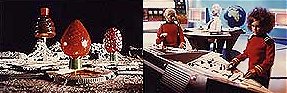 A
Gerry Anderson-produced television commercial for Jif
dessert toppings
A
Gerry Anderson-produced television commercial for Jif
dessert toppings
|
|
|
   
|
|




 SixtiesCity 2008