|
|
 Offshore
Pirate Forts & Sealand Offshore
Pirate Forts & Sealand |
|
|
|
The
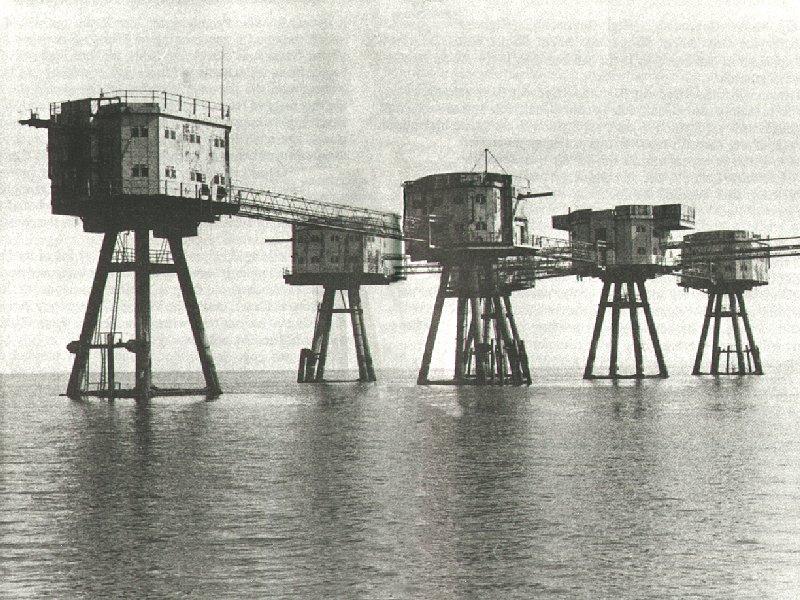
offshore Maunsell forts, or towers, which interested the
pirate radio operators of the Sixties, were originally World
War II military facilities built to protect the coastal
sea lanes and were essentially of two designs.
< click
to see original condition >
|
|
| ss |
Red
Sands, Shivering
Sands and Great
Nore were Army constructed, originally consisting of seven
separate towers, each set on four concrete legs supporting
a steel structure 100ft above sea level and connected by narrow
catwalks. The towers were towed out on specially constructed
barges, two at a time, and set into the sea bed. Red
Sands was put in place between July 23rd and September
23rd 1943 at 51.28.62 North 0.59.60 East and Shivering Sands
between September 18th and December 13th 1943 at 51.29.95
North 1.04.48 East.
Great Nore tower had been completely uninhabitable since the
mid-fifties and was demolished in 1958 as it was blocking
the main approach to the Thames ports. Both
types were designed to house various gun installations ( quite
visible on many pictures ) to combat the twin threats of enemy
aircraft and E-boats. |


Station Map |
|

They
were all designed by Guy A.Maunsell, who submitted many designs
to the military for consideration, and were constructed by Holloway
Brothers at Gravesend in Kent. The Army Forts were constructed
in 1942 subsequent to the successful construction and deployment
of the Navy forts. Each Army construction followed the same
basic design, comprising of a Bofors gun tower, a control tower,
four AA gun towers and a searchlight tower which were arranged
with the control tower at the centre, the Bofors and AA towers
arranged in a semi-circular fashion around it with the searchlight
tower being positioned further away but still linked directly
to the control tower via a high level walkway.
 |
It
is worth noting that a great variety of sea forts were
constructed around the UK during WW2 but
did not figure significantly in pirate radio activities
either due to location (broadcast range) or non-existence
- most
were destroyed immediately after the war as they interfered
with shipping lanes. Had they survived, it would have
been interesting to see whether they would have attracted
the interest of would-be radio stations. The attraction
of the Thames forts was, of course, that they still existed
and were perceived to be outside British territorial limits.
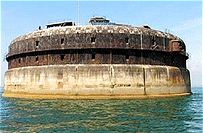
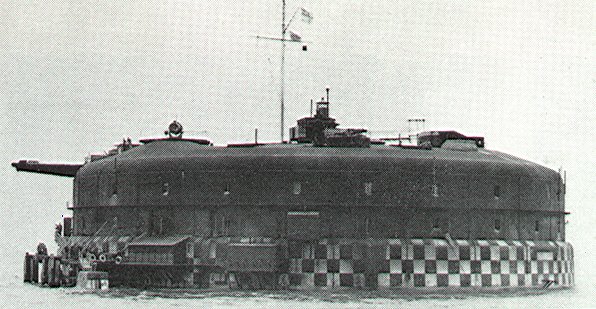
The Solent forts, typified by
Horse
Sand Fort, were
also used in the second world war but had originally been
constructed between 1861 and 1880 as part of a defence
system against the threat of Napoleon and became known
as 'Palmerston's Folly'. The chain of forts runs all round
inland Portsmouth and out into the Solent. |
|
The
original navy forts weighed 4500 tonnes and their armament
consisted of two 4.5" guns mounted on the main decks,
four Lewis machine guns and two Bofors 40mm guns on
the upper deck with the central wood and steel tower
supporting a radar scanner dish.
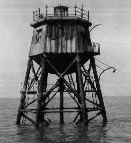
There was one other marine structure in the area at
the time was also considered by many to be one of the
'pirate' towers. This was Gunfleet
and was a kind of lighthouse, looking like a water tank
on stilts - not dissimilar to one of the single sections
of the Army forts. The
forts were not a popular posting and were abandoned
wholesale by the military at the end of the war after
which ownership became a matter of opinion as they were
generally considered to be situated in international
waters and not subject to any particular mainland jurisdiction.
In fact, the War Office seemed to be rather keen to
pass responsibility for them onto other government departments
having tried, unsuccessfully, to sell them off in 1963.
This
didn't really matter, of course, as they were doing
no harm and were of no real practical use to anyone
- until pirate radio came along!
|
|
By an extremely
questionable interpretation of an obscure passage in the Geneva
International Convention of the Sea, 1958, which was ratified
in September 1964 by the British government in an Order in
Council:
'The ( Thames
) estuary may be considered as a bay if the area of water
within the bay exceeds that in a semi-circle drawn, with a
24 mile baseline, across the indentation in the coast'
|
... and
another debatable decision which considered sandbanks
visible only during unusually low tides at certain parts
of the year to be part of the British mainland, all
of the towers, except Roughs and Sunk Head, were declared
to be inside territorial waters and therefore subject
to prosecution under the Wireless and Telegraphy Act.
The area of water in the bay, 683 square miles as calculated
by a Ministry of Defence naval surveyor, was only 5
square miles more than that inside the theoretical semi-circle!
The last military maintenance teams were withdrawn from
the towers in the winter of 1958/59 and by the Sixties
all the offshore towers were already in a state of considerable
neglect and disrepair, offering at best only a bare
minimum of facilities and were to prove impossible to
supply for long periods during bad weather.
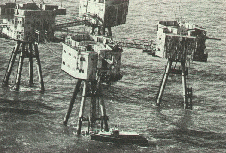
This is part of a description of Shivering Sands, which
was the home of RADIO CITY. The fort had lost one of
its towers when a ship ran into it, killing four people:
".
. . one section had collapsed and another was standing
all alone where the walkways had collapsed."
|
|
|
|
Also, being
in open sea areas and constructed largely of metal,
they were natural lightning conductors. On Red Sands,
D.J. Paul Beresford of RADIO 390 was actually struck
by lightning, not only surviving but managing to broadcast
his usual programme only hours later! Even on good days
huge build-ups of static electricity were apparently
a problem and there are many recounted tales of station
staff being thrown some distance after carelessly grabbing
metal door handles. Minor things like that, however,
didn't seem to be any deterrent to the more determined
pirate radio station operators. The planned final destruction
of the towers commenced on 21st August 1967 when a team
of 20 Royal Engineers demolished
the upper sections of Sunk Head using 2200lbs of explosives,
in front of a specially invited audience of television
and press reporters, with a blast that could be seen
both from the Radio Caroline ship and by Roy Bates on
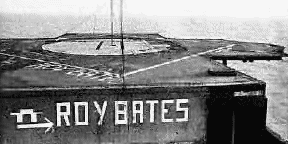
Roughs tower six miles away. During 1967 Roy Bates had
declared the platform, which is supported by 75ft concrete
pillars, to be an 'independent nation' named Sealand
and proclaimed himself monarch.
|
|
Later that
year the Royal Navy attempted to remove him from the
structure but abandoned the attempt when they were met
with warning shots fired from the tower. Following this
incident legal action was brought against him by the
government but was subsequently dropped when the courts
ruled that they had no jurisdiction outside British
territorial waters. During 1978 Sealand was invaded
by some Germans who then proceeded to claim ownership
of the fort. Roy launched a counter-offensive, capturing
a German prisoner in the process which necessitated
the German Embassy to send an envoy to negotiate his
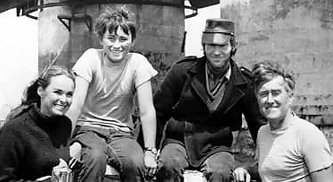
release. 'King' Roy and
'Queen' Joan still occupy the site periodically
and have put considerable effort into having its independence
internationally recognised. This cause was dealt a blow
in 1987 when the U.K. extended its territorial waters
from 3 miles to 12 miles. Their current claim depends
on whether it can be legally established that its independency
was recognised before that date, in which the 1967 court
ruling seems to lie in their favour.
|
|
Roy
of Sealand proclaimed the Constitution of the Principality
on 25th September 1975. Gradually, items of national identity
were produced such as the flag of the Principality of Sealand,
a national anthem, stamps and its own currency - gold and
silver coins designated as Sealand Dollars. 'Official passports'
for the Principality of Sealand were issued to people who
had, in some way, helped the birth of Sealand but were never
at any point for sale.
In August 1978, a number of Dutchmen employed by a German
businessman arrived at Sealand, ostensibly to discuss potential
business dealings. In Roy's absence they kidnapped his son
Michael and took Sealand in a coup d'etat. Roy recaptured
Sealand with his own 'troops' and imprisoned the usurpers
as prisoners of war, during which time the governments of
both Germany and The Netherlands petitioned for their release.
They did ask England for diplomatic intervention but were
turned down, with the British government explaining that they
made no claim on the territory and citing the court decision
as reason for their refusal. The others had no choice but
to recognise Sealand's sovereignty and Germany even went so
far as to send a diplomat to negotiate for the release of
the German 'prisoner'.
The Dutch prisoners were the first to be released under the
Geneva Convention which requires the release of all prisoners
when a state of war does not exist. The sole German continued
to be held as, at some stage, he had apparently accepted a
Sealand passport and was technically guilty of the crime of
treason. Prince Roy, in the interests of Sealand's reputation,
eventually released the man without charge.
On 1st October 1987 Britain extended the limit of its territorial
waters from 3 nautical miles to 12, but had been beaten to
the punch by Roy who, the previous day, had declared his own
extension of Sealand's territorial waters to a similar distance
to ensure that access to Sealand could not be blocked by British
territorial waters. To date, no official agreement has been
signed between Sealand and Britain regarding the resulting
overlap in claimed jurisdiction but a general policy of dividing
the area between the two countries down the middle has been
unofficially followed. International law does not allow the
claim of 'new' land by the simple extension of sea rights
and so Sealand's sovereignty was still guaranteed. Under this
law, neither 'country' can claim rights to any part of the
nother that falls within its 'new' boundary and it is to its
credit that Britain has made no further attempts to take Sealand
but still treats it as an independent State. Following a ruling
by the DHSS, Prince Roy pays no British National Insurance
during the time he spends on Sealand.
There was another incident involving firearms in 1990 when
warning shots were fired at a ship that had strayed too near
Sealand. The crew of the ship subsequently made formal complaints
to the British authorities but, despite Britain's severe prohibition
of firearms, the government chose not to pursue the matter
indicating that the Home Office still considers Sealand to
be outside their umbrella of control.
During 1997, a number of forged Sealand passports started
turning up across the world, some of which were apparently
used to open bank accounts in various countries under false
names. Less than 300 official genuine pasports were in existence
therefore it was unlikely that the items would be detected
as forgeries due to the fact that hardly anyone had ever seen
one. The source was eventually traced back to the same the
same German who had unsuccessfully attempted to take Sealand
by force.
He had created an unofficial 'Sealand Business Foundation'
that allegedly sold over 150,000 fake passports before being
found out, resulting in the curious facty that there are now
probably 500 times as many forged Sealand Passports in circulation
than official ones. Apparently, a large number of the passports
were being sold to people leaving Hong Kong during the Chinese
reoccupation for a dollar each. During
early 2000 Spanish police brought action against criminals
that had set up a website selling fake Sealand 'passports'
which are suspected of having been used by illegal arms and
drug-dealing rings. One of these fake 'passports' was also
encountered by police investigating the murder of fashion
mogul Gianni Versace.
The current government of the Principality of Sealand states
that "The Principality of Sealand recognises 'jus gentium'
and has undertaken to regulate any activity with a view to
compliance with 'jus gentium' and international law or to
have it regulated." The acceptance and recognition of the
Principality as an independent state, or country, has been
demonstrated frequently over the last thirty years by both
European and other States, but particularly Britain, which
has stated unequivocably on a number of occasions that it
has no jurisdiction within Principality territorial limits
or that it takes no interest in events occuring within the
jurisdiction of the Principality. In addition, many legal
experts have carefully examined the arguments for and against
Sealand sovereignty and have agreed with unanimity that 'jus
gentium' applies as the basic principle of law supporting
Sealand's independence.
Due to failing health, Prince Roy has more recently reviewed
the arrangements that have been in place for decades and,
looking towards the future of the Principality, appointed
his son, Prince Michael, the Prince Regent as 'Sovereign pro
tempore' by Royal Decree in 1999.
In
June of 2000 an Anguillan-based company called HavenCo announced
preliminary plans to locate its servers and satellite uplinks
on the Sealand platform provided its independent status could
be validated. That
company now exclusively leases offices and operations centres
in Sealand, where it offers, and is able to offer, unparalleled
security and independence to users who wish to take advantage
of its Internet colocation services. The purpose of this is
to allow companies using its servers to avoid the government
scrutiny which will be made possible by laws to be taken up
by the U.K. and U.S.A. although HavenCo insist that it will
not allow any form of illegal trading. Sealand, of course,
has no laws regarding the control of data traffic.
More
and larger pictures of the pirate forts may be found in my
Image Gallery and
there are some fabulous pages in pirate links
|
|










 SixtiesCity 2009