|
|
The
design was modified to include four-wheel drive and power was increased
with the introduction of a second engine (almost predictably leading
it to be called the 'Twini') but nothing financially viable could
be done about the low ground clearance inherited from its 'Mini'
lineage. The modified designs were again rejected by both the British
and American armies and the vehicle never made it beyond the prototype
stage as a military vehicle. Eventually BMC abandoned hopes for
any military application, but not the basic concept. It was decided
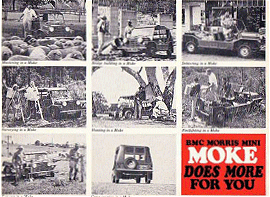
to market a low-cost, easily maintained civilian version for light
commercial applications such as farming and further modified prototypes
were produced, one or some of which are still in existence. Not
all the endeavour for a military application went to waste as some
early promo material focussed on the vehicle's lightness by showing
four soldiers off-roading in a Moke and lifting it up and carrying
it by its tubular bumpers when the terrain became too much for its
(naturally downplayed) low ground clearance.
The strange name 'Mini Moke' is made up of two parts. The 'Mini'
obviously alludes to its Mini heritage and the alliterative 'Moke'
is a slang term for a donkey, which was probably hoped that it would
be thought of as a kind of 'workhorse'. The American brochures actually
read:
"Own a four-passenger donkey! The Austin Mini Moke is as tough
and versatile as its namesake, but not half so obstinate. The rugged
transverse-mounted BMC engine, combined with front wheel drive,
makes it sure-footed on the roughest terrain. Carrying a load, caddying
around the golf course or coursing over back roads and beaches,
the Austin Mini Moke is the real 'can do' vehicle. A lot more economical
than a donkey, too!"
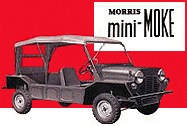
The Moke was launched on the British market in 1964, first being
built at the Morris factory in Oxford before moving to BMC's Longbridge
plant in Birmingham. Mokes made in Britain were powered by a single
848cc (later 1098cc then 1275cc) engine, detuned to use low-octane
fuel, and the same wheels (10 inch), suspension and gearbox as a
standard Mini. It took nearly 22 seconds to reach 60mph with a top
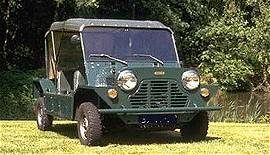
speed of around 65. Original 'Mark 1' Mokes were fitted with a floor-mounted
headlight dip switch and a single windscreen wiper (which was not
necessarily vital as the windscreen could easily be unbolted and
removed if not needed!). Optional 'extras' included passenger seats,
grab handles, heater, windscreen washer and a removable canvas top,
all of which had to be fitted by the owner. The only colour option
was a dark 'Spruce Green'.
At a price of just £405 it cost less than any other four-wheeled
car on the market. The bizarre reason for this was that it wasn't
actually viewed as a 'car' by Customs & Excise, who classified it
as a commercial vehicle, therefore no purchase tax was payable!
Of course, once you'd purchased the Moke, you could easily 'convert'
it into a car by adding passenger seats and other 'extras'. A conversion
company, Crayford Engineering, produced about 20 Mokes fitted with
four seats, striped upholstery and a fringed Surrey top for export.
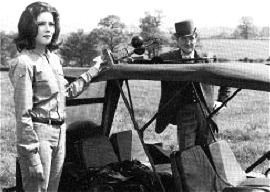
One remained in the UK and was used as a taxi in the TV series 'The
Prisoner'. A variety of other Mini-based vehicles were also subject
to modification and conversion inside Crayford's workshops including
the Cooper, Wolseley Hornet and Clubman.
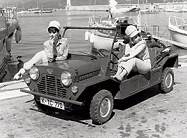
Ultimately, about 90% of the 14,518 Longbridge-made Mokes were exported
to hot countries for use as 'beach buggies', hotel 'tourist taxis'
and even police cars! With the bad winters of 63 and 64 the original
idea of four-wheel drive by way of 'adding an engine' was resurrected.
This initially proved to be a bit of a problem as it was difficult
to synchronise both engines and the dual gear-changes but a compromise
solution was reached by fitting an automatic power unit in the back.
A 'Mark 2' was announced in 1967 to include changes that had been
made to the Mini (the horn and headlight controls now mounted on
the indicator stalk), plus a second windscreen wiper as standard
and a choice of two colours - the original 'Spruce Green' or a new
'Old English White'. This resurrected Customs interest in the vehicle,
ending its 'tax dodging' by reclassifying it as a car. This raised
the UK price by £78 and severely damaged sales when the marque was
already under threat as the mergers within the British automotive
industry had brought Land Rover into the same stable.
British manufacture ended in October 1968 after 14,518 had been
built, of which all but 1,467 had been exported. A team of Mokes
equipped with roll bars and the Mini Cooper S 1275 cc engine were
entered in autocross grass track competitions in 1968 by the John
Player cigarette company but full 'cult' status was mainly achieved
as a result of its appearance in film and television productions,
particularly the ATV series 'The Prisoner', James Bond movies, notably
'The Man With The Golden Gun' and 'Pop' movies such as the DC5's
'Catch Us If You Can'.
Australian Moke production started in 1966 and continued right up
until 1981. To start with they were built exactly like the British
larger 13 inch wheels were fitted after a few months as this made
them a more practical prospect for beach and off-road use with the
slight increase in ground clearance. At the end of UK production
in 1968 all the remaining tooling was transferred to the Sydney
production site. A later version called 'The Californian' was made
more attractive by sporting a 1275 cc engine and vastly improved
seating. A pick-up version with a cloth top and drop sides was introduced
in 1975. As in the U.K. a four-wheel drive version also became available,
but this was achieved with a single engine that applied power to
the rear via a transfer box.
In 1981 production (now British Leyland) was transferred to the
Portuguese subsidiary where a further 8,500 'Californians' were
produced in the ten years to 1991. Now called the Rover Group, manufacturing
rights were sold to motorcycle manufacturer Cagiva, who continued
production in Portugal for a further two years, making a further
1,500 Mokes before deciding to transfer work to Italy, but it was
effectively the end of the line for the Moke. In all, about 50,000
Mokes were produced. 14,500 were produced in the UK between 1964
and 1968, 26,000 in Australia between 1966 and 1981 and 10,000 in
Portugal between 1980 and 1993.

Crayford
Minis Heritage
Motor Centre The
Mini Moke Club
|









 SixtiesCity
2007
SixtiesCity
2007