|
Click on the banners to see the relevant pages |
|
1960s
 |
|


|
|





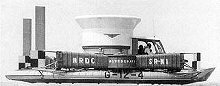


Saunders Roe and Vickers combined in 1966 to form the British Hovercraft Corporation. During the decade other commercially viable craft were also developed in Britain, notably by Cushioncraft Ltd. ( formed in 1960 as part of the Britten-Norman aircraft manufacturing group) and Hovermarine. The Hovermarine craft differed in design in that the solid sides of the hull projected down into the water to trap the cushion of supporting air. By the end of the Sixties the largest British hovercraft in service were the SR-N4 'Mountbatten' class craft which were powered by four Rolls-Royce 'Tyne' engines. These were large and powerful enough to be able to carry both cars and passengers across the Channel to Calais from bases in both Ramsgate and Dover and only ceased operation in 2002 when the Channel tunnel became operational.
Passenger Aircraft
BEA

| BEA (British European Airways ) was formed by Act of Parliament in 1946 and operated the European and North African routes from many airports throughout the U.K. It was also Britain's largest domestic airline, operating internal flights to all major cities and, during the Fifties and Sixties, was usually the first to order the latest medium and short-haul aircraft from British manufacturers, such as the BAC 1-11, the Hawker-Siddeley Trident and the Vickers Viscount and Vanguard. The Viscount was a turbo-prop medium range aircraft, the first of it's kind to enter service, introduced by Vickers-Armstrong in 1953. The short-haul |
 |
| BAC
1-11 was actually designed by Hunting Aircraft but was manufactured
by BAC (British Aircraft Corporation) after Hunting was merged with
several other British aviation companies in 1960. The short and medium
range Trident, DH121 and HS121, was of Fifties De Havilland design
built by the Hawker-Siddeley Group in the 1960s subsequent to their
merger with other companies. BEA continued under it's own banner until
1973 when it was merged with BOAC (British Overseas Airways Corporation)
to form British Airways. BOAC BOAC came into being in 1939 as the
result of previous mergers of smaller companies and, at the time,
as a direct result of the merger between Imperial Airways Ltd and
British Airways Ltd. Imperial Airways was formed in 1924 as a result of several mergers involving Aircraft Travel and Transport Ltd., Handley Page Transport Ltd., Instone Air Line Ltd., Daimler Airway, and British Marine Air Navigation Co. Ltd., and operated flying boats from Southampton to British colonies in Africa, Asia and Australia from the Thirties until November 1950 using aircraft such as the Short Empire and Short Calcutta 'flying boats' to carry both passengers and mail. The Short S.23 'Empire' and S.8 'Calcutta' were manufactured by Short Brothers of Northern Ireland. |
 |
British Airways Ltd. came about in 1935 as a result of several mergers (Spartan Air Lines Ltd., United Airways Ltd. and British Continental Airways Ltd.) and was first formed as Allied British Airways in October 1935, operating in Europe. On acquiring Hillman's Airways Ltd. it changed it's name to British Airways Ltd., adopting a winged lion as it's emblem and transferring it's headquarters to the newly-built Gatwick Airport. It started life with a strange mixture of aircraft including the Junkers Ju52 and the DeHavilland 'Express' but fierce European competition soon resulted in acquisition of more modern craft such as the Dutch-made Fokker F8 and F12 as it expanded it's operation across the European capitals and major cities. On moving into European markets further east in Hungary and Poland it acquired the American-built Lockheed Electra L-10.
BOAC

The two companies were not direct competitors, British Airways Ltd being a private company concentrating on Europe and the more romantic Imperial Airways, with it's state subsidy, servicing the more far-flung outposts of the British Empire, but were merged shortly after the outbreak of World War II to form a single state-owned carrier - BOAC - The British Overseas Airways Corporation (BOAC).
Shortly after the war, the Civil Aviation Act of 1946 led to the demerger of two of it's divisions to form three separate corporations:
BOAC (British Overseas Airways Corporation) - Empire, North American and Far East routes
BEA (British European Airways) - European and domestic routes
BSAA (British South America Airways) - South American and Caribbean routes
BSAA was originally named British Latin American Air Lines (BLAIR) and was split from BOAC to operate their South Atlantic routes. It began transatlantic services in March 1946 from London Heathrow Airport. It operated mainly 'Avro' aircraft, the 'York', 'Lancastrian' and 'Tudor', and flew to Bermuda, the West Indies and the West coast of South America. The company was plagued by strange incidents, including the unexplained losses of the Tudors 'Star Tiger' and 'Star Ariel' which were attributed to the mysterious Bermuda Triangle and the 'Stendec Incident' involving the loss of the Lancastrian 'Stardust' in the Andes after sending only a partly readable radio message. (The discovery of the wreckage of Stardust in 2000 subsequently indicated an unremarkable accident). BSAA was in the process of planning to introduce De Havilland Comets in 1949 when it was merged back into BOAC.
| With the Comet 4, BOAC became the first airline to fly transatlantic passenger jet services in 1958. In 1956 BOAC had ordered 15 American Boeing 707s, thus beginning a relationship which would make British Airways the biggest Boeing customer outside of North America. The next major order was for 11 Boeing 747-100s. A significant domestic order was placed for 12 Vickers VC-10s in 1957. The specification of these was written for BOAC's specific requirements. BOAC also acquired 17 stretched Super VC-10s. |
 |
BOAC became the first airline to use a passenger jet, the De Havilland Comet, in May 1952. After three of the Comets were involved in crashes during a short period investigators discovered serious cracks in the structure of the planes and all Comet I aircraft were grounded in April 1954. De Havilland subsequently designed an improved Comet, the Series 4, which avoided the problems of pressurisation stresses.
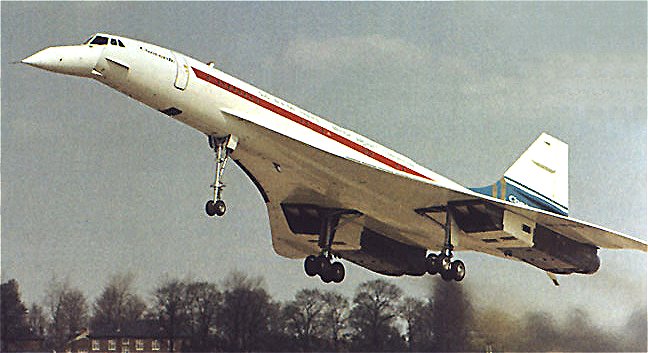
The company took possession of it's first Boeing 747 on April 22nd 1970, but this did not enter commercial service until April 14th 1971 due to industrial action by the British Air Line Pilots Association. The British Airways Board was formed on September 1st 1972 as a holding board that controlled both BOAC and BEA. On March 31st 1974 BOAC and BEA were dissolved and merged to form British Airways. Interestingly, if not for this merger, BOAC would have been one of the first operators of the Concorde, and one of BA's Concordes actually carried the registration G-BOAC.
London Airports
 |
1960
The number of passengers flying in British airspace is 10,075,000
(DfT) with 5.27 million using Heathrow (CAA) 1961 The Oceanic Building opens at Heathrow for long haul flights. It later becomes Terminal 3. 1966 The British Airports Authority is formed to own and operate Heathrow, Gatwick, Stansted, and Prestwick airports. Freddie Laker launches his budget service Laker Airways, later 'Skytrain', operating out of Gatwick. 1967 Stansted is designated London's third airport. 1969 The new Terminal 1 is opened at Heathrow. (It is now Heathrow's busiest terminal, handling 24 million passengers a year and home to 14 airlines). The existing Europa and Oceanic buildings are later renamed Terminals 2 and 3. The opening marked the beginning of a £30m investment programme that saw Terminal 3 extended and runways lengthened from 9,000ft to 12,000ft to accommodate the new Boeing 747 Jumbo Jets. The car parks are also expanded and bus and underground stations follow later. |
Charter Airlines
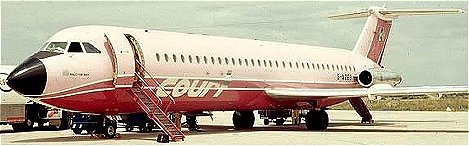
| Court Line was a UK holiday charter airline in the late 1960s and early 1970s. In conjunction with Clarksons Holidays it pioneered cheap package tours to Spain and other sunny destinations, opening up a whole new opportunity to the British holidaymaker. Originally named Autair International, it became subject to a complete 'makeover' in 1970 and was relaunched as Court Line Aviation with it's BAC 1-11s painted a variety of unusual pastel colours. Aircrew wore trendy Mary Quant-designed uniforms and the whole experience was geared up to make passengers' often first flying experience a fun one. |
 |
British Railways

The main British rail transport system developed during the 19th century. The grouping of the Railways Act 1921 created four main companies, each covering a specific geographic area:
GWR (Great Western Railway), LMS (London, Midland and Scottish Railway), LNER (London and North Eastern Railway) and SR (Southern Railway)
The London Underground and the Glasgow Subway systems remained as independent operators as did a small number of industrial and light railways and local tramways, but these did not constitute a significant mileage compared to the system as a whole.
| The
railways were put under government control during the second World
War, during which time they suffered heavy bombing damage and general
neglect due to the war effort. The Transport Act of 1947 led to the
nationalisation of the network as part of a policy by Clement Attlee's
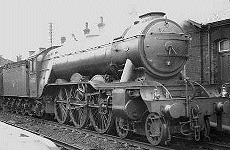
Labour Government to nationalis all public services. As a result of this, British Railways came into being on 1st January 1948 with the merger of the four regions under the overall control of the Railway Executive of the British Transport Commission. Concentrating on the UK mainland, services owned by LMS in Northern Ireland were sold off to the Stormont Government in 1949 to be controlled by the Ulster Transport Authority. The new system was subdivided into six geographical regions instead of the previous four and this remained the basic operational structure of British Railways until the Eighties, with an element of independence but also a fair degree of centralisation: |
 |
The British Transport Commission's 1955 Modernisation Plan recommended the outlay of £1,240 million over a period of 15 years for bringing the network up to date. Included in this were plans to make the rail service more attractive to passengers and freight operators who had, for a long period, been increasingly turning to road transport. The three main proposals were Electrification of mainline routes, Wide-scale introduction of diesel and electric engines and replacement of old coaching stock to replace steam and a major investment in Renewal of signalling and track.
| A
1956 White Paper proclaimed that this modernisation would assist in
eliminate BR's cash deficit by 1962. However, it failed to take into
account the growth of mass road transport and the effect on the traditional
role of the railways. This resulted in vast amounts of money being
wastefully invested in things like marshalling yards when small wagon-load
operations were in fast decline. British Railways were also fettered
by archaic freight charge regulations which forced them to transport
unprofitable freight. This severely affected any possibility that
the railways could compete with road transport and made profitability
an impossible dream. In the face of huge losses, the plan was reconfigured in 1959 to speed up rationalisation and modernisation. This resulted in huge orders for new diesel engines, then only under development and which were to prove unsuitable at a later date. In 1962 the British Railways Board was created to supersede the British Transport Commission which was also responsible for road transport and the canal systems, in addition to the railway network. 1963 saw the publishing of the 'Reshaping of British Railways' by BR chairman Dr. Richard Beeching. In a bid for rationalisation, many unprofitable rural lines were closed, the Beeching 'axe' also falling on most branch lines and even some main lines. This period also witnessed the "Great Locomotive Cull", with mass replacements of steam engines with diesels, and of course far fewer were needed on the pared-down rail system. The bell finally tolled for the days of steam on the networks in the North-West of England during August 1968. Regardless of this, the industrial use of steam locomotives on independent lines, most notably those run by the National Coal Board, continued well into the 1970s. Although a small number of steam locomotives were preserved, most fell victim to the scrapyards. |
 |
Between 1958 and 1974 the West Coast main line was gradually subjected to overhead line electrification to the French standard AC voltage of 25kV 50Hz. Many passenger lines in the London and Glasgow areas were also electrified and Southern Region pushed it's 750V DC 3rd rail system out to the Kent coast. Despite all this electrification, it never achieved the system-wide efficiency that European railways were enjoying. On the 'death' of steam in 1968 the operation was relaunched under the name 'British Rail' and it was at this time that the double-arrow logo, still used to represent the industry, was introduced along with the standardised typeface used for communications and signs and the "rail blue" livery which was applied to nearly all locomotives and rolling stock. The logo was somewhat unfortunate as it prompted some cynics to suggest that it meant the railway "didn't know if it was coming or going"). During the 1960s the TOPS system for classifying locomotives and multiple units was introduced. Hauled rolling stock continued to carry a separate series of numbers. Also during this period the bright yellow 'noses' - yellow warning panels - were added to the front of diesel and electric locomotives and multiple units in an attempt to increase the safety of track and line workers. In 1970 the major engineering works were hived off into a separate company - British Rail Engineering Limited.
Cruise Lines and Liners

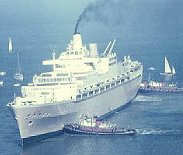
In 1960, the two major British lines trading with the far east, the Orient Steam Navigation Company and P&O, agreed a merger at a time when each had it's largest liner to date already under construction, the 'Oriana' and the 'Canberra'. Built by Harland and Wolff in Belfast, these were the largest ships to be built in the UK in 20 years.
| Both had unusual features: The 'Canberra' had twin funnels located side-by-side towards the aft of the ship and her lifeboats were slung low in the hull, with several decks above them. Now very commonplace, this was revolutionary at the time. Canberra usually sailed between Southampton and Australia with occasional world cruises. At 44,800 GRT, she could carry 2,100 passengers in two classes or 1,737 on a single class cruise. By 1973 the air travel industry was booming and P&O began removing older ships from it's fleet. The Canberra was briefly diverted to Caribbean cruises in an unsuccessful partnership with Cunard before returning to resume cruises from Southampton. Like the QE2, Canberra saw action in the Falkland War and was finally withdrawn and scrapped in 1997. |
 |
| Of
even stranger design was the Oriana, with two funnels of completely
different design - the forward one being nearly two storeys higher
than the aft. Her bridge was nearly amidship and crowned a series
of terraced decks and a long bow. At 41,915 GRT and 804 feet long,
she was built in Barrow-in-Furness by shipmakers Vickers-Armstrong,
joining Canberra on the Australia run in 1960 until 1986. She has
since been used as a floating hotel in Japan and, more recently, Dalian,
China. She capsized in a storm in 2003 but managed to be righted. P&O merged with the British India Company in 1914 and by 1932 had a fleet of 41 ships, including 21 passenger liners. The government requisitioned the entire P&O fleet for war service in 1939, only 13 of which survived. These remaining vessels were ageing badly by 1960 when P&O merged with Orient and the two new liners became the mainstay of their fleet. During the Seventies P&O purchased Princess Cruises (of TV 'Love Boat' fame) which was later to merge the Italian cruise line SITMAR. Princess is now promoted as a separate operation, mainly to the American market, while their "classic" liner fleet is targeted extensively at the British market. |
 |
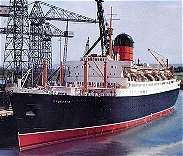
Acquired by Cunard in 1948, the 'Caronia' was one of their first ships to be specifically designed for cruising. From the outset, she was very popular and remained profitable for nearly all of her eighteen year service. For a time she was painted in four different shades of pale green (excluding her traditional red-and-black funnel), and was familiarly known as the "Green Goddess". On becoming unprofitable to operate, she parted ways with Cunard in 1967. Following a series of name changes and ill-fated operations she ran aground and broke up at Guam in the summer of 1974 on her way to a breakers yard in Taiwan.
| The
four sister ships Carinthia, Ivernia, Saxonia and Franconia were each
608 feet long and drew 21,947 GRT and were built for Cunard's Canadian
service in the Fifties. By 1962, the only one of the four remaining
on that route was the Carinthia. The Carinthia and another ship, Sylvania, were sold to the Italian cruise line SITMAR in 1968. They were extensively modernised and renamed - Carinthia becoming Fairland (later Fairsea) and Sylvania acquiring the more elegant Fairwind. Fairsea also experienced another major refit in 1984 before the ships returned to British ownership when SITMAR was bought by P&O in 1988. Naturally, there were more name changes, Sylvania/Fairwind becoming Dawn Princess and Carinthia/Fairland/Fairsea becoming Fair Princess. Dawn Princess was later sold yet again, to a German line, and is now named Albatros. Fair Princess replaced Fairstar in the Australian budget cruise business before being sold on to an Asian company and is now known as China Sea Discoverer. |
 |
The Ivernia and Saxonia were renamed in the 1960s, becoming the Franconia and Carmania respectively, and treated to the same green paintwork as the Caronia. The two ships continued to cruise for Cunard until 1972 when they were sold off to Russian interests. The Franconia was renamed Fedor Shalyapin and the the Carmania became known as the Leonid Sobinov, the latter being broken up in India in 1999.
| Bigger
than Queen Mary, her older sister ship, Queen Elizabeth was built
by John Brown & Co. at Clydebank, Scotland, and officially launched
in 1938, construction, fitting-out and trials being completed in 1940.
At 1,029 feet long, 118ft wide and 83,673 GRT she looked similar to
the Queen Mary but was constructed with two stacks instead of three.
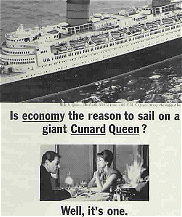
Being World War II, Queen Elizabeth was immediately commandeered as a troop carrier, going straight from the shipyard to America. She finally achieved her destiny when she began transatlantic passenger crossings six years later, with three classes of accommodation catering for 2,288 passengers. She and the Queen Mary carried out the transatlantic run in tandem for the next 20 years when, for a brief period in the Sixties, Cunard tried using them for winter cruises due to lack of passengers. By this time, transatlantic flight was becoming faster and more popular, reducing the market for the big ships. It was decided that the Queens were also too big for cruising and they were finally withdrawn from service in 1968. In 1970, the Queen Elizabeth became the Seawise University for C.Y.Tung. She was to be converted and used on worldwide cruises carrying students and others but, in 1972, just before completion, she caught fire and sank in Hong Kong harbour, and was later broken up where she lay. |
 |

|
All
Original Material
 SixtiesCity 2008
 |
